
Turning Lab-Stage Water Technology into a Testable MVP Direction
Helped an early-stage startup clarify where its water sanitation technology could have the strongest adoption logic, then translated that direction into a product concept, ecosystem assumptions, and validation metrics for future testing.
Context
Aquamox had developed a technology that could convert regular water into an environmentally friendly sanitizer. The technology was promising, but the product opportunity was still unclear. The client needed help understanding who the product should serve, where it could fit in the market, and how the technology could become something people would actually use.
Our work focused on moving the idea from a lab capability to a commercially viable product concept for early market validation.
Snapshot
Role
Product Design Consultant/
User reseacher
Timeline
~ 16 weeks
Project Type
Team
0→1 pilot strategy · Human + AI workflow design· Service model definition · Pilot evaluation
Instructional designer· AI vendor · Digital learning expert · Deputy Vice Provost for Online Learning
-
Core Challenge
The Ask
The client asked us to identify user pain points and market gaps in the water sanitation industry, then develop a product concept that could support early market validation.
What we learned
People already have cleaning routines, products, workarounds, and trust patterns around hygiene. A new product would need to fit into those behaviors instead of asking users to change them completely.
The work moved from:
Novel water sanitation technology
to
The real challenge
The challenge was to understand where the technology could create real value, what adoption barriers might exist, and which customer context had the strongest early-market potential.
Where would people trust this technology enough to use it?

My Role
This was a collaborative consulting project completed by a small team. My contribution focused on turning the concept into tangible and testable artifacts. I supported field studies to understand sanitation behaviors, then worked on:
Field Studies
Research Synthesis
Product prototypes
BMC and validation metrics
Working presentations on reseach update and product updates
How We Scoped the MVP Direction
Phase 1: Research + Synthesis
The first phase was about separating what the technology could do from where it had the strongest chance of adoption. I contributed through field studies and helped connect the findings to the product direction we would later make tangible.

Phase 2: Product Direction
The ideation workshop helped define what the concept needed to communicate. I worked on the prototype direction and digital wireframes to make those criteria visible.
Phase 3: Business + Validation
A good prototype can make an idea feel real, but it can also create false confidence. I used the Business Model Canvas and set of adoption metrics to surface the assumptions behind the concept to help the client test whether users would understand, trust, and return to the product beyond initial interest.
What the field studies made clear
The field studies made the adoption problem clearer: Aquamox could not rely on “better sanitation” as the whole value proposition. In kitchens, users already had familiar routines, so any new step needed to create an obvious payoff. In outdoor contexts, the product had a stronger opening because campers and RV users were already managing water limits, storage constraints, and waste.

Field studies with users to understand hygiene context!


The Decision
Follow the Strongest Adoption Logic
Journey mapping, Jobs-to-Be-Done, and the adoption feasibility matrix helped narrow the customer direction by clarifying where the technology had a stronger job, clearer constraints, and better validation potential.
Once that direction was clearer, a 60-minute ideation workshop with 3 campers helped narrow the product concept: 30 minutes of Miro card sorting to identify user values, existing “haves,” and adoption barriers, followed by 30 minutes of prioritization to define must-haves, form possibilities, and usability needs.
That sequence mattered because it kept us from jumping straight into a prototype. First, we clarified who the product should serve; then we defined what the product needed to communicate.
The team collabrated in Miro to create collect and synthesis the reseach data!
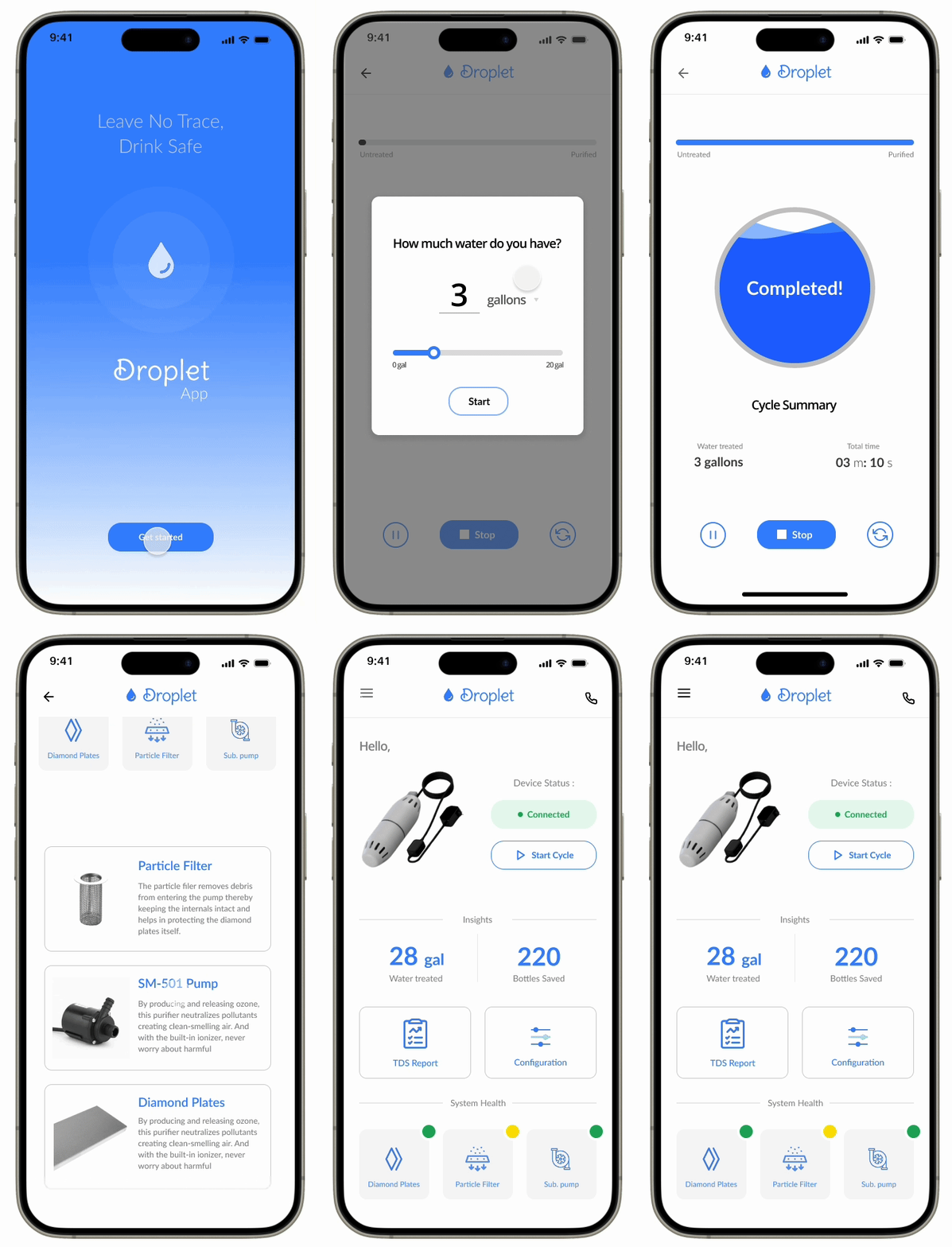
Droplet: The MVP Direction
Droplet was developed as a portable sanitation concept for campers, RV users, and off-grid contexts.
The product direction was shaped around a simple idea: users in these contexts already think about water, storage, waste, and low-impact living.

Intial product form exploration sprints!

Testing the Product Logic
Once Droplet became the MVP direction, I worked on the Business Model Canvas and TIO Framework to make the concept testable beyond the prototype.
I developed a Business Model Canvas because the product was entering a niche market where the risk was not just about usability, but about whether the value proposition, customer segment, distribution channel, and long-term adoption logic made sense.


Testing 3D printed prototypes with campers!
TIO Framework helped us evaluate adoption beyond first impressions: whether users were comfortable with ozone technology, trusted the sanitation cycle, fit it into their routines, and continued using it over time.

Value Created
-
Gave an early-stage startup a clearer first market to test by narrowing the scope toward a more focused early-adopter space.
-
Turned a technical capability into a product direction that investors, partners, or users could understand.
-
Reduced early product risk by using the BMC and TIO metrics to clarify customer fit, distribution assumptions, trust barriers, and what needed to be tested before deeper investment.
-
Created a practical path to validation so Aquamox could evaluate whether this direction was worth developing further before committing to a larger build.
Key Learnings
1. A broad technology needs a specific adoption context.
The stronger move was not to design for every possible use case, but to find where the need, constraints, and behavior change were clear enough to test.
2. Prototypes are strongest as decision tools, not proof.
The 3D prototypes and wireframes made the concept easier to question, compare, and refine without claiming a final design.
3. Trust must be designed when the value is invisible.
Because users could not easily see the sanitation process, feedback and guidance became central to the product experience.
Here is what I discovered through the work.